

- Introduction
- How Does the Academic Layout Fit Modern Healthcare Standards?
- What Makes the Clinical Training Framework Distinct at Doiwala?
- Which Nursing Pathways Can You Pursue on the Campus?
- How Do the Campus Facilities Support Demanding Medical Studies?
- How Does the Placement Cell Secure Your Clinical Future?
- Hospital Training and Midnight Rotations
- Strategic Faculty Mentorship and Research Focus
- Semester Tuition and Basic Eligibility
- Working Inside the Simulation Labs
- Community Health Outreach and Rural Medical Engagement
- Comprehensive Eligibility Criteria and Smooth Admission Protocols
- Understanding the Regulatory Muscle of INC Approval
- Evaluating the Long-Term ROI of a Dehradun Medical Education
- What Is the Long-Term Value of Your Final Academic Choice?
A medical emergency does not wait for you to look up textbook definitions. When a patient goes into sudden shock on a midnight ward shift, you either know how to respond instantly or you fail. Most local academies keep you trapped in clean classrooms playing with plastic models. It won’t be wrong to say it is a dangerous way to learn medicine. Why waste time with passive observation when choosing the best Nursing college in Dehradun puts you directly into active clinical situations?
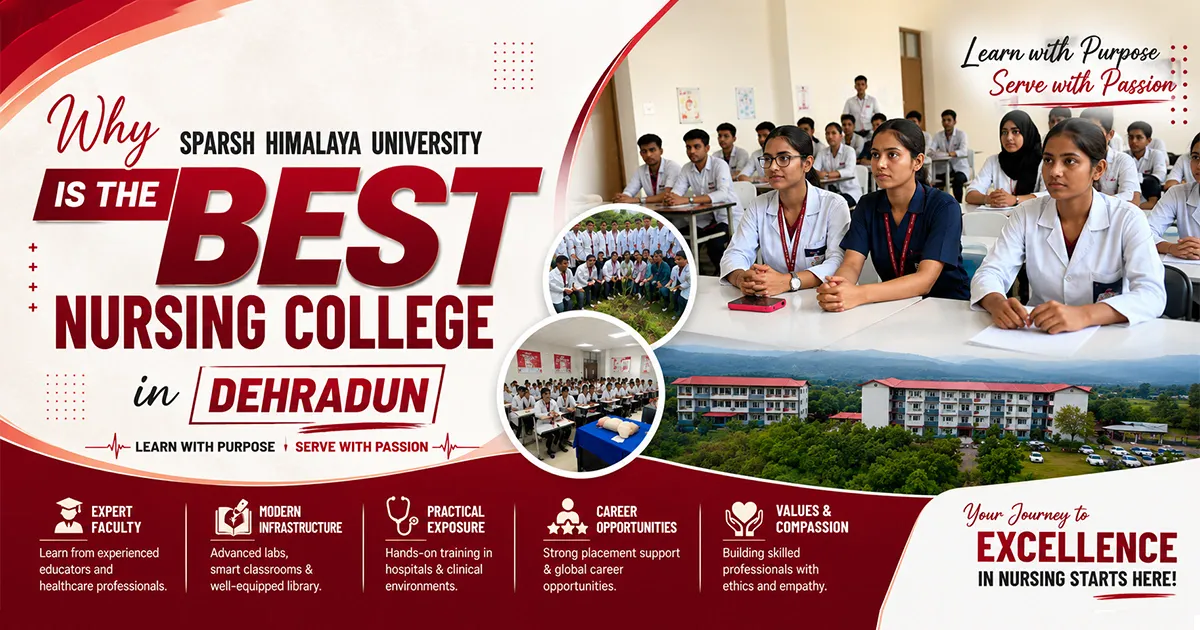
The training ground that you select determines both your earning capacity and even whether or not you survive in the hospital environment. There is a particular arrangement in which Sparsh Himalaya University trains its students at Fatehpur Tanda in the Doiwala region. The lecture halls are situated next to the woods of Song River, totally away from the hustle and bustle of the busy streets of Dehradun. The training ground gives you the opportunity to concentrate on factual information, such as dosage details and anatomical logs.
How Does the Academic Layout Fit Modern Healthcare Standards?
Medical sectors demand absolute legal accountability and precise technical compliance. The institution operates cleanly as one of the premium Indian Nursing Council (INC)-approved nursing colleges in Uttarakhand. This statutory verification ensures that every lecture hour, laboratory cycle, and hospital assignment complies with the national benchmarks set by the Indian Nursing Council. You follow a systematic, semester-based curriculum built to convert theoretical biological concepts into repeatable clinical habits.
The layout of the training process completely avoids basic memory tricks in favor of more advanced triage strategies. The trainees are actually deconstructing tough pharmacology formulas, assigning medication doses and computing accurate intravenous drips all under time pressure. Such a training process will prepare your mind for working in the hospital environment. Once you graduate, you will have the necessary calmness required to deal with an unstable patient’s vital signs and sudden bodily changes.
What Makes the Clinical Training Framework Distinct at Doiwala?
Classroom study holds little value if you cannot apply it directly to actual human pathology cases. The university integrates intense clinical exposure directly into early academic semesters instead of saving it for graduation periods. You do not just read about surgical preparation or wound management in standard textbooks. Instead, you enter active clinical floors to observe real healthcare procedures.
Learning how to deal with blood will never be achieved simply sitting in the back row of a classroom. The university runs its daily training right inside a functioning parent hospital network. This implies that you abandon the artificial plastic models and follow the doctors during their daily rounds.
You hold your own medical equipment, check heart monitor machines, and learn how to maintain surgical trays amidst a busy environment. Your learning process will no longer be theoretical; it will become practical knowledge.
Which Nursing Pathways Can You Pursue on the Campus?
Different areas of the healthcare market demand distinct entry methods. The university operates multiple educational tracks to match your explicit professional plans.
Students looking for quick entries into general nursing roles regularly evaluate the GNM nursing colleges in Dehradun fees structures. This three-year track establishes a solid foundation in everyday ward mechanics and fundamental bedside management. Alternatively, you can target long-term healthcare leadership roles through the four-year undergraduate track. The institution positions itself at the top of the top B.Sc nursing colleges in Dehradun by weaving independent medical research variables into standard laboratory cycles. You escape generic health summaries to focus entirely on advanced nursing diagnostics, pediatric care variants, and mental health protocols.
How Do the Campus Facilities Support Demanding Medical Studies?
Professional medical training requires extensive hours of absolute mental focus and long laboratory experiments. The institute rejects cramped commercial locations to offer an expansive, purpose-built infrastructure.
Training Facility Component | Core Technical Utility |
Anatomy & Simulation Labs | Advanced physical procedure practice on realistic task trainers |
Advanced Data Computer Labs | Real-time tracking of electronic health records and medical metrics |
Medical Library Wings | Direct access to recent national healthcare journals and publications |
Your physical setup determines your ability to learn on a daily basis. The University provides hostel facilities which are located within the campus premises of Doiwala. This means that you do not have to endure long commutes through regional mountain paths. You are guaranteed proper meals, conducive studying environments, and access to the laboratory after the lectures finish.
How Does the Placement Cell Secure Your Clinical Future?
Graduating with high practical marks is only the first step in building a sustainable medical career. The campus runs an active placement cell that connects final-year students with major national healthcare networks. This department bypasses passive online job boards to create direct hiring paths into top-tier medical centers.
Recruitment executives run formal corporate interviews right inside the university department blocks. The placement coordinators train you through intensive clinical interview drills, resume structure reviews, and professional presentation workshops. This focus ensures you exit the university block and enter the workforce at an elevated professional rank with a stable salary package. You join the medical grid as a fully functional clinician prepared for immediate deployment in critical care wards.
Hospital Training and Midnight Rotations
The nursing student learns best while dealing with actual emergencies late into the night on their ward rotation. The university structures its practical hospital hours to match when local medical cases peak during the year. You don’t waste your time sitting around in empty rooms reviewing past cases.
The training team throws you straight into active ICUs, bustling ERs, and even the pediatric wards. The format of the rotations compels you to deal with diverse patients while still a student. Your days will involve charting post-operative recovery progress, maintaining sterility while assisting with minor procedures, and documenting the precise quantities of fluids.
This prepares you for stepping into a highly-paced hospital setting in the future without being overwhelmed. You get an idea of what nurses really talk like at work. That is being able to interpret doctor’s notes accurately, decipher imaging results within time constraints, and communicate with oncoming shifts about patient information.
Strategic Faculty Mentorship and Research Focus
Nursing excellence is something that can only be gained with the help of professionals who have years of experience in dealing with complex cases within hospitals. Our faculty at the Himalayiya College of Nursing comprises seasoned professionals with advanced specialization in fields such as cardiovascular nursing, mental health care, maternity, and neonatology.
Our faculty members do not just lecture from standard textbooks. They bring real case files into the classroom, forcing you to think like an active clinician from day one. This guidance becomes especially vital during your specialized research cycles.
The university places a strong premium on local healthcare research. Here you acquire skills related to recognizing the epidemiology trends in the region of the foothills of Uttarakhand, understanding rural health issues, and writing scientific articles. This aspect of evidence-based practice will help you rise above a mere clinical assistant and become a scientific healthcare professional. You will be able to support your medical decisions with scientific data; this is what makes you unique during the job-hiring process.
Semester Tuition and Basic Eligibility
For the 2026–2027 batch, your basic tuition fee per semester is Rs. 62,500 if you belong to the All India category. If you live in Uttarakhand and have state papers, your tuition comes down to Rs. 46,750 per semester. To apply for a seat, you must clear your 10+2 board exams with Physics, Chemistry, Biology, and English.
Single Payments at Entry
Once you pass the entrance examination, you can lock your seat and have to deposit certain one time fees starting with a registration fee of Rs. 2,500 and an enrollment fee of Rs. 1,000. The basic admission cost is a fixed sum of Rs. 25,000. Apart from that, there is a vaccination fee of Rs. 1,500 and a medical processing fee of Rs. 3,000.
Recurring Yearly Charges
The cost of laboratory maintenance and use of the campus bus to transport students to the hospitals has to be incurred on a fixed basis every year. In this regard, you will be expected to pay an amount of Rs. 10,000 every year towards maintenance of the library as well as the labs. You will also have to make an annual payment of Rs. 10,000 towards transport services. An additional charge of Rs. 5,000 is made for other campus related activities while Rs. 4,000 is charged for sports activities.
Working Inside the Simulation Labs
What happens when your very first cardiac patient starts flatlining right in front of you? If that moment occurs on a live human being in a busy ward, the pressure can completely freeze your mind. The university uses advanced simulation laboratories to stop that from happening. These rooms look exactly like real emergency wards.
You spend your training hours working on computerized mannequins that act like real people. The machines can drop their pulse rates in seconds, stop breathing entirely, or show bad physical reactions if you give them the wrong drug dosage.
Instructors watch your moves from behind one-way glass windows. They count the seconds it takes your team to grab the defibrillator paddles or clear a blocked airway. And once the drill finishes, you sit down to watch the video playback of your mistakes so you can fix your hand movements and talk clearer next time. This setup means you face worst-case scenarios dozens of times before you ever touch a real patient.
Community Health Outreach and Rural Medical Engagement
True nursing competence extends beyond the clean, air-conditioned corridors of private city hospitals. The state of Uttarakhand presents unique geographical and infrastructural healthcare challenges, particularly across its remote hill sectors. The university integrates mandatory community health outreach phases directly into your professional curriculum.
You travel in dedicated university transit networks to rural clusters around Doiwala, Rishikesh, and adjacent foothill villages. During these field deployments, you set up functional diagnostic camps, track maternal health metrics across local populations, and conduct vital healthcare awareness drives.
Such an experience helps you understand how to handle patients in a situation where you have to take care of them within minimum medical facilities. You get to know about the social aspects of the medical profession, and how to deliver complicated medical processes to the people living in rural areas in a sympathetic yet clear manner.
Comprehensive Eligibility Criteria and Smooth Admission Protocols
Securing entry into the top B.Sc nursing colleges in Dehradun requires meeting strict academic prerequisites designed to test your baseline scientific comprehension. The admission board processes every student file through a highly systematic, non-negotiable verification sequence.
Basic Age Requirements
It is essential that you attain the age of seventeen years and above before December 31 of the year you join the nursing cohort. The registration department of the institution does not entertain any exemptions when it comes to meeting the deadline set for these requirements.
Documents Required by Schooling Institutions
It is important that you provide evidence of passing your 10+2 examinations in the following subjects: physics, chemistry, biology, and English core, which is a subject offered in all high schools.
Qualifying Marks Requirement
The selection panel ensures that you scored not less than forty-five percent in science subjects. These marks must have been earned from a recognized examination board.
The selection office processes incoming registration forms directly through the prescribed entrance test performance metrics. Shortlisted names appear on a public merit list, which triggers an invitation to the Doiwala campus for face-to-face academic counseling.
During this session, an internal medical board runs standard health checkups to ensure you possess the physical stamina required for grueling ward shifts. Simultaneously, an administrative committee verifies your original credentials, migration records, and regional domicile certificates before issuing your final seat allocation paperwork.
Understanding the Regulatory Muscle of INC Approval
Many students overlook the legal structure of their chosen college, only to discover later that their degrees lack national validity. Sparsh Himalaya University removes this risk completely through its permanent alignment with statutory national bodies. Being counted among the recognized INC approved nursing colleges in Uttarakhand guarantees that your degree carries full legal weight across every state in India.
The Indian Nursing Council maintains rigid quality controls regarding teacher-to-student ratios, laboratory square footage, and hospital bed counts. The university undergoes regular institutional audits to maintain this status.
For you, this means your educational hours convert smoothly into valid professional licenses upon graduation. You can register with any state nursing council across the country without needing remedial coursework or face unexpected institutional rejections when applying for central government hospital positions.
Evaluating the Long-Term ROI of a Dehradun Medical Education
Choosing the location of your professional training requires balancing educational quality with overall living costs. Dehradun has developed into a major national educational hub, yet it avoids the hyper-inflated living costs and extreme pollution found in metro cities. The Doiwala campus provides an ideal environment for rigorous study.
Your return on investment shows clearly in the employment metrics of our recent graduating classes. While general degree holders face stagnant employment markets, our specialized nursing postgraduates and undergraduates step directly into active career roles.
The stable fee structure, combined with the lack of expensive daily transit costs due to on-site housing, makes this track highly efficient financially. You save significant resources while securing a level of technical preparation that usually requires double the investment in metropolitan private academies.
What Is the Long-Term Value of Your Final Academic Choice?
Sticking to a comfortable, low-risk routine keeps your professional growth totally flat. A basic desk job will not transform into a high-tier clinical leadership role without a serious upgrade in your technical skills. By selecting the Best Nursing college in Dehradun for your professional development, you break out of the baseline employment pattern immediately.
The Himalayiya College of Nursing cuts past general textbook overviews to force direct, daily engagement with active patient care metrics and modern medical systems. This training changes how you handle physiological crises. Secure your registration during the early merit allocation windows. It remains the most reliable way to stand out when healthcare recruitment teams begin auditing applications for the upcoming 2026–2027 clinical hiring cycles.
FAQs
INC approval ensures your degree maintains full legal validity across all states in India. Graduating from an unapproved institution can block you from securing state licenses or applying for central government hospital jobs.
The annual fee covers secure on-campus housing, balanced meals at the dining hall, continuous electricity supply, and direct proximity to the laboratory blocks. This setup eliminates daily travel stress completely.
The university utilizes a tiered fee framework that lowers costs for local state residents. Candidates with an Uttarakhand domicile pay a tuition fee of Rs. 11,000 per semester. Candidates applying from other states across India pay a tuition fee of Rs. 15,000 per semester.
Yes, the university accepts registrations from candidates across India. While local domicile holders can access specific state scholarships, the basic eligibility criteria remain identical for all national applicants.
Clinical schedules scale up as you move into advanced semesters. Your time shifts from early observation rounds to full, intensive ward shifts, covering critical care, labor rooms, and emergency triage.
Seat allocations happen strictly in order of merit list rankings. If you miss your scheduled counseling window without prior official permission, your slot passes automatically to the next qualified candidate in line.

 Apply Now
 Fee Structure
 Enquiry
 Quick Links