

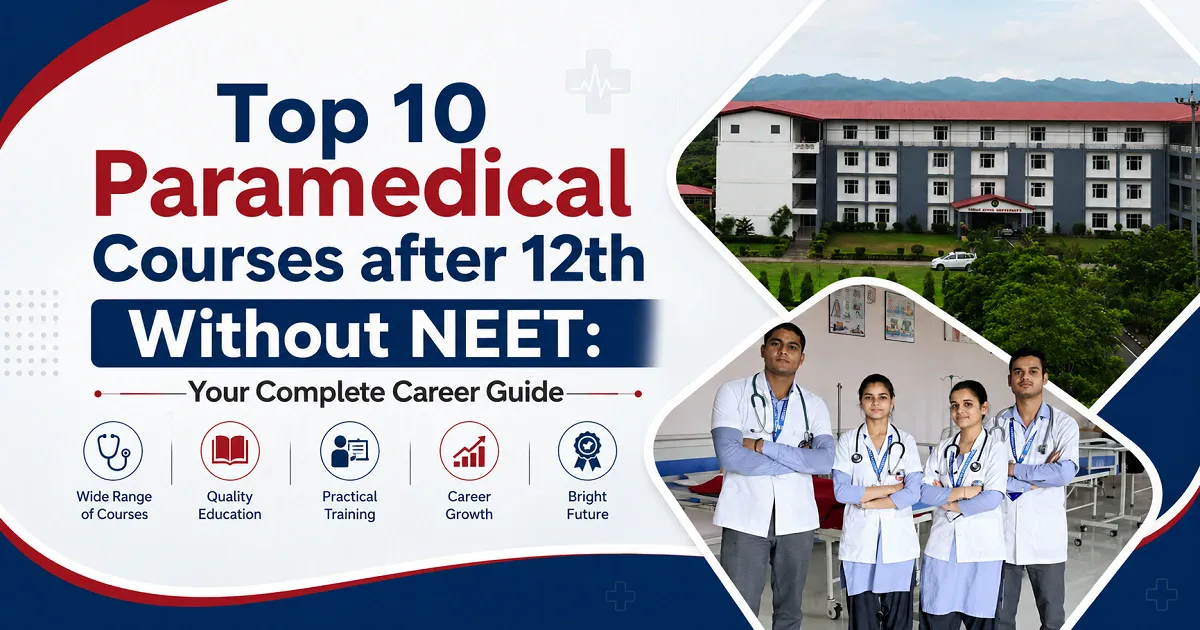
- Introduction
- What is paramedical education?
- Paramedical Course Eligibility Criteria
- Top 10 Best Paramedical Courses After 12th Without NEET
- Comparison of Key Paramedical Courses
- Benefits of Selecting Paramedical Courses in India
- Common Mistakes Students Make During Admissions
- Selecting the Right Paramedical College in Uttarakhand
- Expert Insights on What Hospitals Look For in New Graduates
- Conclusion and Actionable Next Steps
- FAQs
Did you know that nearly 80% of critical healthcare decisions depend directly on diagnostic lab results and medical imaging rather than a doctor’s initial physical exam? While the National Eligibility cum Entrance Test (NEET) remains the standard route for MBBS aspirants, it is not the only pathway into the medical sector. The healthcare system requires a massive workforce of specialized professionals to run diagnostic machinery, manage emergency rooms, and handle rehabilitation therapies.
If you want to make it to the field of medicine quickly without having to face the highly competitive NEET exam, choosing paramedical sciences is your best bet. This blog provides an honest look into the best paramedical courses after 12th, with all the details related to eligibility criteria, core subjects, and employment opportunities in India.
What is paramedical education?
To build a career in this field, you must understand “what is paramedical science.” Paramedical courses train students to become pre-hospital medical professionals, diagnostic experts, and therapeutic clinicians. These specialized workers support doctors by conducting blood tests, operating X-ray units, managing surgical equipment, and handling trauma care.
When discussing the details of paramedical courses, there are basically three different academic paths available in India:
- Degree Courses (Bachelor’s): It takes 3 to 4 years to complete such courses and provides highly technical knowledge, along with a compulsory hospital internship.
- Diploma Courses: It is a two-year course that mainly concentrates on technical knowledge.
- Certificate Courses: This one-year to six-month-long course provides entry-level knowledge for technician jobs.
For long-term career growth and better salaries, undergraduate degree programs remain the preferred choice for parents and students across the country.
Paramedical Course Eligibility Criteria
Before selecting a specific stream, you must satisfy the basic eligibility rules established by state allied health councils and universities.
- Academic Qualification: You must pass your 12th standard board examination from a recognized educational board.
- Subject Stream: Science stream is mandatory. You must have studied Physics, Chemistry, and Biology (PCB) or Mathematics (PCM) as core subjects.
- Minimum Marks: Most universities require an aggregate score of at least 45% to 50% in your 12th board exams.
- Age Limit: You must be at least 17 years old by December 31 of the admission year.
Top 10 Best Paramedical Courses After 12th Without NEET
The following degree programs represent the best paramedical courses after 12th in terms of market demand, salary growth, and industry stability.
1. B.Sc. in Medical Laboratory Technology (BMLT)
This degree focuses on the analysis of body fluids, chemical balances, and blood cells. Medical laboratory technicians are responsible for running tests that identify malaria, diabetes, cancer, and bacterial infections.
- Duration: 3 Years plus 6 months internship.
- Core Subjects: Clinical Biochemistry, Hematology, Blood Banking, Medical Microbiology, and Histopathology.
- Employment Roles: Laboratory Manager, Hematology Technician, Quality Control Officer.
- Where to Study: Available at private institutions like Sparsh Himalaya University in Doiwala, Dehradun, which provides direct access to diagnostic training labs.
2. B.Sc. in Radio Imaging Technology (BRIT) / Radiology
Medical imaging technicians operate specialized radiation equipment. If you choose this course, you will learn to produce internal images of the human body to spot fractures, tumors, and internal bleeding.
- Duration: 3 Years plus 6 months internship.
- Core Subjects: Radiation Physics, X-Ray Positioning, Anatomy, MRI Technology, CT Scan Mechanics, and Patient Care in Radiology.
- Employment Roles: Radiology Technologist, MRI Specialist, X-Ray Technician, Application Specialist for medical imaging brands.
3. Bachelor of Physiotherapy (BPT)
Physiotherapists treat patients recovering from physical trauma, sports injuries, or neurological conditions. They use manual therapies, mechanical exercises, and electrotherapy modalities to restore movement.
- Duration: 4 Years plus 6 months compulsory hospital rotation.
- Core Subjects: Exercise Therapy, Biomechanics, Orthopedics, Neurology, Electrotherapy, and Human Anatomy.
- Employment Roles: Sports Physiotherapist, Rehabilitation Specialist, Consultant at private orthopedic clinics.
4. B.Sc. in Operation Theatre Technology (BOTT)
Operation theatre technologists prepare surgical environments before a procedure starts. They manage sterile fields, calibrate anesthesia machines, and assist surgeons during complex operations.
- Duration: 3 Years.
- Core Subjects: Surgical Procedures, Sterilization Protocols, Anesthesia Drugs, Anatomy, and Advanced Surgical Equipment Handling.
- Employment Roles: OT Technician, Anesthesia Assistant, Surgical Store In-charge.
5. B.Sc. in Optometry
Optometrists check eyes for any vision defects. They also prescribe corrective lenses, and identify early signs of ocular diseases. They can either work independently in optical outlets or alongside ophthalmologists in eye hospitals.
- Duration: 3 Years classroom learning plus 1 year clinical internship.
- Core Subjects: Ocular Anatomy, Visual Optics, Contact Lens Procedures, Low Vision Aids, and Binocular Vision.
- Employment Roles: Optometrist, Refractionist, Lens Specialist, Clinic Manager.
6. B.Sc. in Dialysis Technology
Those patients who suffer from kidney related disorders need artificial filtration (i.e. dialysis) to survive. Dialysis technologists control hemodialysis machines, take care of patient’s vital signs, and ensure the fluid equilibrium of patients during dialysis treatment.
- Duration: 3 Years.
- Core Subjects: Renal Anatomy, Dialysis Fluids, Machine Maintenance, Nephrology Pharmacology, and Patient Monitoring.
- Employment Roles: Dialysis Therapist, Renal Clinic Supervisor, Medical Equipment Service Engineer.
7. B.Sc. in Cardiac Care Technology
The cardiac care technologists assist the cardiologists with performing invasive procedures like angioplasty and pacemaker insertion in the OTs. They have to be able to do things like running an electrocardiograph (ECG) machine and cardiac monitoring in ICUs.
- Duration: 3 to 4 Years.
- Main Subjects: Echocardiography, Electrocardiography, Invasive Cardiology Procedures, Cardiovascular Pharmacology, and ICU Monitoring.
- Job Opportunities: Cardiac Care Technologist, ECG Technologist, Cath Lab Technologist.
8. B.Sc. in Emergency Medical Technology
Emergency medical technicians are the first point of contact at any scene of an accident, disaster, or medical emergencies. EMTs stabilize their patient in the ambulance and coordinate trauma care triage centers within hospital emergency departments.
- Program Length: 3 Years.
- Subject Courses: Trauma Care, Advanced Life Support, Toxicology, Disaster Management, and Emergency Drugs.
- Occupational Positions: EMT, Ambulance Service In-charge, Trauma Center Coordinator.
9. B.Sc. in Physician Assistant
This is an interesting course. Physician assistant works closely with the doctors and conducts preliminary physical exams, documents patient histories, and helps doctors with regular ward rounds. They act as an important link between the nursing staff and the chief consultants.
- Duration: 3 Years.
- Core Subjects: Clinical Pharmacology, Diagnostic Methods, Ward Management, Patient History Documentation, and General Medicine.
- Employment Roles: Medical Assistant, Clinical Coordinator, Health Records Executive.
10. Bachelor of Audiology and Speech-Language Pathology (BASLP)
This specialized course focuses on speech and hearing disorders. Professionals treat children with speech delays, stutters, and adults recovering from strokes that damaged their language abilities.
- Duration: 4 Years.
- Core Subjects: Otology, Audiological Diagnostics, Articulation Disorders, Hearing Aids, and Neurogenic Language Disorders.
- Employment Roles: Audiologist, Speech Therapist, Speech Pathology Consultant in special schools or hospitals.
Comparison of Key Paramedical Courses
Name of the Course | Duration | Qualification Needed | Common Job Roles |
B.Sc. Medical Laboratory Technology | 3.5 years | 10+2 with PCB (minimum 50%) | Clinical laboratories, diagnostics lab, blood banks, and research laboratories |
B.Sc. Radiology & Imaging Technology | 3.5 years | 10+2 with PCB or PCM (minimum 50%) | Radiology departments in Hospitals, diagnostic imaging centres, and imaging facilities |
Bachelor of Physiotherapy | 4.5 years | 10+2 with PCB (minimum 50%) | Physiotherapy clinics, rehabilitation centres, hospitals, and sports medicine facilities |
B.Sc. Operation Theatre Technology | 3 years | 10+2 with PCB (minimum 45%) | Operation theatres, surgical departments, and critical care units |
B.Sc. Optometry | 4 years | 10+2 with PCB or PCM (minimum 45%) | Eye hospitals, vision care clinics, and optical retail chains |
Benefits of Selecting Paramedical Courses in India
Enrolling in paramedical courses in India offers specific structural advantages over standard traditional degrees.
- No NEET Score Required: You can bypass the intense pressure of national competitive exams. Admission criteria depend on your 12th merit scores or university-level screening tests.
- Rapid Employment Turnaround: Unlike an MBBS, which takes over five years, a standard paramedical degree gets you into active hospital jobs within three to four years.
- High Industry Demand: The expansion of corporate hospital chains across tier-2 cities has created a continuous shortage of certified lab technicians and OT assistants.
- Skill-Based Security: Your career rests on your technical ability to operate specific diagnostic tools, making your job safe from automated software shifts.
Common Mistakes Students Make During Admissions
Many aspirants choose their college or course based on weak information, which limits their career path later.
- Ignoring Council Approvals: Always check if the university operates under the relevant state paramedical council or statutory guidelines. Unrecognized degrees will disqualify you from government job vacancies.
- Skipping Practical Lab Inspections: Do not rely on brochure photographs. Visit the campus to check if the computer labs, anatomy models, and diagnostic machines are functional.
- Underestimating Internship Locations: A paramedical student learns the most during actual hospital postings. Ensure your university has active tie-ups with high-footfall hospitals.
Selecting the Right Paramedical College in Uttarakhand
Location is a major factor when you pick your training center. If you join a paramedical college near busy hospitals, you get to see real patient care much faster.
Sparsh Himalaya University sits right on the Dehradun-Haridwar National Highway in Doiwala. This private institution was set up under Uttarakhand State Act Number 8 of 2019. At this campus, the School of Paramedical & Health Sciences teaches you using actual equipment instead of just textbooks. They offer popular courses like the Bachelor of Medical Laboratory Technology (BMLT), Bachelor of Medical Radiology and Imaging Technology (BMRIT), and B.Sc Optometry.
Studying at this university in Dehradun puts you close to regional medical centers. This handy location means you can easily finish your compulsory hospital training and internships without moving to another state.
Expert Insights on What Hospitals Look For in New Graduates
Academic performance is what qualifies a person for interviews, but at the same time, employers want graduates to be comfortable working in practice. During recruitment, hospitals try to find people who know how to work in the laboratory, how to ensure safety of patients, how to handle the equipment and how to communicate professionally.
For instance, a medical laboratory technologist should be able to perform the diagnostic test with the help of quality control. A radiology technologist must know how to use the equipment, how to protect patients from the possible radiation. Sterility is crucial in operation theatres, where one should also support the surgeon. These skills are obtained through laboratory classes, simulation learning and clinical practices that take place during the course.
Besides, hospitals appreciate graduates who can quickly adjust to their daily routine. While choosing between colleges, it would be beneficial to pay attention not only to the curriculum, but also to such features as laboratory equipment, clinical experience, and hospital connections.
Conclusion and Actionable Next Steps
A paramedical course is one of the many ways to enter the healthcare sector without appearing for NEET. The course you choose should match the kind of work you see yourself doing, whether that is working in a laboratory, assisting in surgeries, helping patients recover through physiotherapy, or operating medical imaging equipment.
Before you decide, compare a few colleges instead of applying to the first one you find. Check the eligibility requirements, visit the campus if possible, and ask about laboratory sessions, hospital training, and internships. Talking to current students can also give you a clearer picture of what to expect. A little research before admission can help you make a more informed decision.
FAQs
The Bachelor of Physiotherapy (BPT) and B.Sc. in Radio Imaging Technology generally command the highest starting salaries. A senior physiotherapist running a private clinic or a specialized MRI technologist can earn between ₹4,00,000 to ₹7,00,000 annually after a few years of experience.
Most degree programs like BMLT, BRIT, and BPT strictly require a science background with Physics, Chemistry, and Biology. However, certain short-term certificate courses or specific diplomas in hospital administration accept students from arts and commerce streams.
Yes, if your direct goal is employment. A traditional science degree often requires a master’s qualification before you find industry roles. Paramedical courses are direct vocational programs that qualify you for hospital jobs immediately after graduation.
Tuition fees vary depending on the chosen facilities and equipment needs. On average, reputable private institutions in the region charge between ₹75,000 to ₹1,20,000 per year, which remains far more affordable than metropolitan medical seats.
Yes. State health departments, railway hospitals, and military medical units regularly advertise vacancies for lab technicians, radiographers, and opticians. You must be registered with your state allied health council to apply.

 Apply Now
 Fee Structure
 Enquiry
 Quick Links