

- Introduction
- The Role of Clinical Experience in Physiotherapy
- Clinical Exposure Matters More Than Campus Size
- What a BPT Degree Actually Costs
- What to Expect During the Internship Phase
- Post-Graduation Pathways: MPT Specializations
- Critical Questions for Campus Visits
- Common Selection Oversights
- What Matters in the End
- FAQs
You shortlist a medical university after reading about its modern lecture halls, high placement statistics, and green campus layout. A week later, you speak with a graduate from that exact program. They share a completely different story. They spent four full years memorizing muscle origin points from textbooks without handling a single post-operative orthopedic patient.
That disconnect happens constantly in health sciences education.
Physiotherapy is an active, manual clinical discipline. Learning how to mobilize a frozen shoulder, manage a ventilator-dependent ICU patient, or rehabilitate an athlete’s torn anterior cruciate ligament requires real clinical settings. The real learning happens on a hospital floor while reviewing patient charts alongside orthopedic surgeons, neurologists, and cardiologists.
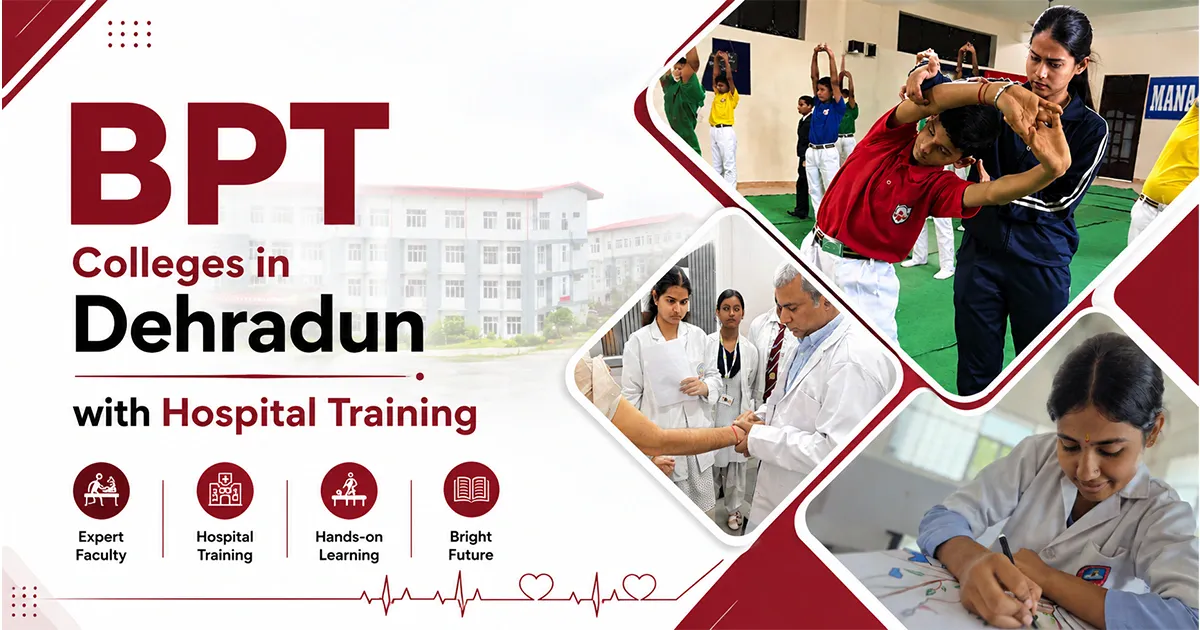
If you are comparing BPT colleges in Dehradun, then there is nothing better than choosing colleges that focus on giving direct hands-on training at hospitals rather than the overall infrastructure of the college itself. Here, we bring all the details about clinical training, costs, and much more before joining.
The Role of Clinical Experience in Physiotherapy
Textbook diagrams show clear nerve pathways and neatly drawn muscle groups. Real human bodies rarely match those static illustrations.
Because physiotherapy relies on hands-on assessment and rehabilitation rather than medication or surgery, practical hospital experience becomes an essential part of professional training.
When evaluating institutions, early access to clinical environments remains the main differentiator. Working inside an active healthcare facility exposes students to distinct specialties:
- Intensive Care Units (ICU): Performing chest physiotherapy, postural drainage, and airway clearance to prevent lung complications in bedridden patients.
- Orthopedic Wards: Treatment of patients recovering from surgeries related to joint replacement, bone fracture fixation, and spine surgery.
- Neurology Clinics: Helping stroke and spinal cord injury patients achieve functional independence.
- Pediatric and Geriatric Care: Modifying mobilization techniques in cases of children with cerebral palsy or geriatric patients suffering from severe osteoarthritis.
Clinical Exposure Matters More Than Campus Size
Many public and private institutes are present in Dehradun that offer allied health courses. But there is a great variation in the level of hands-on training at these institutes.
Most universities can be divided into two types when it comes to clinical education:
- Parent Teaching Hospital: Gives you early access to on-campus outpatient wards, so you get to observe real patient care and complex cases almost daily.
- External Hospital Ties: Rotates you through different regional clinics or government facilities. Just be sure to verify how many clinical hours are guaranteed and how student travel is arranged.
For instance, Sparsh Himalaya University, situated along the Dehradun-Haridwar corridor in Doiwala, operates under Uttarakhand State Act No. 8 of 2019. The university combines academic teaching with its clinical facilities, giving students opportunities to observe patient care, diagnostic procedures, and multidisciplinary healthcare teams during their training.
Colleges relying entirely on external affiliations rely on memoranda of understanding (MoUs). In these cases, checking which specific hospital departments are accessible during the term prevents surprises later.
What a BPT Degree Actually Costs
Before registration, you should have a comprehensive idea about the total four and a half years’ investment cost, which includes the tuition, clinical fees, and administrative fees. Tuition cost may vary based on whether you qualify for the domicile quota from your state. Practical laboratory and hospital training may carry an extra cost.
The following table shows the fee structure for the Bachelor of Physiotherapy (BPT) program in Sparsh Himalaya University (School of Paramedical & Health Sciences):
Academic & Semester Fees
Fee Head | All-India Candidate | Uttarakhand Domicile Candidate | Frequency |
Tuition Fee | ₹34,000 | ₹25,000 | Per Semester |
Clinical Transportation | ₹2,000 | ₹2,000 | Per Semester |
Examination Fee | ₹2,500 | ₹2,500 | Per Semester |
Sports Fee | ₹4,000 | ₹4,000 | Annual |
One-Time Admission Charges
- Registration Fee: ₹1,000 (One Time)
- Enrollment Fee: ₹1,000 (One Time)
- Admission Fee: ₹5,000 (One Time)
- Vaccine & Medical Fee: ₹4,000 (One Time)
- ID Card Fee: ₹200 (One Time)
- Total One-Time Fees: ₹11,200
- Please note that the total amount for the first year’s fee and academic investment is ₹92,200 for All India students and ₹74,200 for Uttarakhand domicile students (without the extra hostel and mess charges), while for other academic years, the fee amounts to ₹81,000 per annum for All India candidates and ₹63,000 per annum for local state candidates.
What to Expect During the Internship Phase
The mandatory six-month rotating internship transforms a student into an independent clinician. Interns work under the direct supervision of senior physiotherapists, orthopedic specialists, and rehabilitation teams.
A structured internship distributes practical hours across five core areas:
- Orthopedics and Traumatology (1.5 Months): A major focus on joint mobilizations, post-fracture rehab, and spinal alignment.
- Neurology and Neurosurgery (1.5 Months): Handling neuromuscular conditions, post-stroke recovery, and gait retraining.
- Cardiopulmonary & ICU (1 Month): Applying chest clearance techniques and post-cardiac surgery recovery protocols.
- Sports Medicine & General Surgery (1 Month): Treating acute soft tissue injuries, ligament tears, and post-abdominal surgery recovery.
- Pediatrics and Community Rehab (1 Month): Managing developmental delays, cerebral palsy, and rural health outreach.
Evaluating physiotherapy internship opportunities in Dehradun early gives a clear picture of the clinical confidence you will build before graduating.
Post-Graduation Pathways: MPT Specializations
After completing a BPT degree, graduates may become eligible for registration with the relevant state regulatory body, subject to applicable requirements. Specialized roles often require postgraduate education, and pursuing a Master of Physiotherapy (MPT) opens opportunities in advanced clinical leadership, research, and academic positions.
Key specialization fields include:
- MPT in Orthopedics: Focuses on joint, bone, and spinal rehabilitation in tandem with orthopedic surgeons.
- MPT in Sports Physiotherapy: Concentrates on athletic performance, biomechanical analysis, and acute field injuries.
- MPT in Neurology: Focuses on central nervous system recovery and long-term neuro-rehabilitation.
- MPT in Cardiopulmonary Sciences: Centers on critical care management and post-cardiac recovery units.
If you already know the specialty you want to pursue, choosing a university that offers both BPT and MPT specializations in ortho and sports can make the transition to postgraduate study much easier.
Critical Questions for Campus Visits
Visits to candidate campuses reveal details that brochures rarely show. Asking these direct questions during an admissions tour clarify essential operational details:
- Is the university fully recognized by state legislative authorities and medical councils?
- Does the institution operate its own functional hospital, or are clinical postings hosted externally?
- How many functional electrotherapy units (SWD, ultrasound, TENS) are available per batch in the labs?
- Do clinical postings start during the early academic years or only during the final internship?
- What is the average daily patient footfall in the college OPD?
Common Selection Oversights
Don’t Get Distracted by the Campus
A modern campus makes a wonderful first impression; however, physiotherapy students have much more time in laboratories and clinics than in the dining hall and recreational areas. Before coming to a conclusion, find out if the electrotherapy apparatus is working and if students can use it.
Overlooking Basic Science Infrastructure
Anatomy serves as the foundation for physical medicine. Inspecting the anatomy lab for detailed models, skeletal sets, and structural diagrams gives insight into how foundational sciences are taught.
Failure to Consider Eligibility for State Council Registration
Registration with the state occupational and physiotherapy council is mandatory for any practicing professional. Therefore, it is important that one checks whether the institution meets the criteria for registration before joining.
Essential Campus Visit Checklist
Take a look inside the practical labs. Don’t just glance through the door. Check whether the electrotherapy and exercise therapy machines are actually working and whether there are enough units for students to practice regularly.
Spend a few minutes in the anatomy lab. A well-maintained collection of osteology sets, anatomical models, and teaching aids usually says a lot about how seriously the university approaches the basics.
Walk past the physiotherapy OPD if possible. You’ll quickly get a sense of whether students are working with real patients under faculty supervision or simply observing from a distance.
Talk to a couple of senior students. Third- and fourth-year students are usually the best source of honest information about clinical postings, hospital shifts, faculty support, and how much hands-on work they actually receive.
If hospital training is off campus, check the travel arrangements. A posting at a good hospital is valuable, but long daily commutes without reliable transport can make clinical schedules much more demanding than they appear in the brochure.
What Matters in the End
Choosing among the various BPT colleges in Dehradun with hospital training comes down to how much real patient interaction you will get before graduating. Modern classrooms and large campus lawns are pleasant extras, but they will not help you perform a respiratory clearance in an ICU or manage a post-surgical knee rehabilitation.
Before submitting your application, visit candidate campuses in person. Walk through the practical laboratories, speak with third- and fourth-year students about their clinical shifts, and confirm the university’s actual hospital affiliations. Securing a strong clinical foundation during your undergraduate years is the single most important step toward building a successful career in physical medicine.
FAQs
NEET is not mandatory at many institutions, although admission criteria vary by university. Admissions usually depend on PCB (Physics, Chemistry, Biology) marks in 10+2, though some institutions offer merit scholarships based on NEET scores.
The BPT degree lasts four and a half years. This includes four years of academic coursework and laboratory practice, followed by six months of mandatory rotating clinical internship.
Graduates can practice in multi-specialty hospitals, establish private rehabilitation centers, work with sports clubs, or join corporate ergonomics programs. Many also opt for specialized MPT degrees or clinical research roles.
BPT is an undergraduate degree covering general physiotherapy across all major medical domains. MPT is a two-year postgraduate degree concentrating on a specific branch like orthopedics, sports, or neurology.
The use of the "Dr." prefix by physiotherapists varies depending on professional guidance, state practices, and institutional policies. Students should follow the applicable regulations where they intend to practice.
First-year coursework focuses on basic medical sciences, including human anatomy, human physiology, biochemistry, psychology, and basic healthcare concepts.
Before you decide where to study, think about the kind of physiotherapist you want to become. Prioritizing direct hospital exposure, verifying total course costs, and checking laboratory infrastructure will guide you toward an institution that prepares you for real clinical practice.
Key Takeaway: Practical competency in physiotherapy grows through hands-on patient evaluation. Prioritizing consistent hospital exposure over basic campus amenities ensures a strong foundation for clinical practice.

 Apply Now
 Fee Structure
 Enquiry
 Quick Links